The Need for a New Approach to Teaching Cultural Artifacts
For many years, Teacher Wang Chen-Ting faced the challenge of transforming students' curiosity about jade artifacts into actual creative output. Students could analyze or redesign jade in 2D, but once they needed to convert their ideas into 3D objects suitable for VR exhibition, progress often came to a stop. Traditional 3D software demanded weeks of training, time that students simply did not have, and many quickly lost confidence. As a result, their creativity remained trapped on paper.
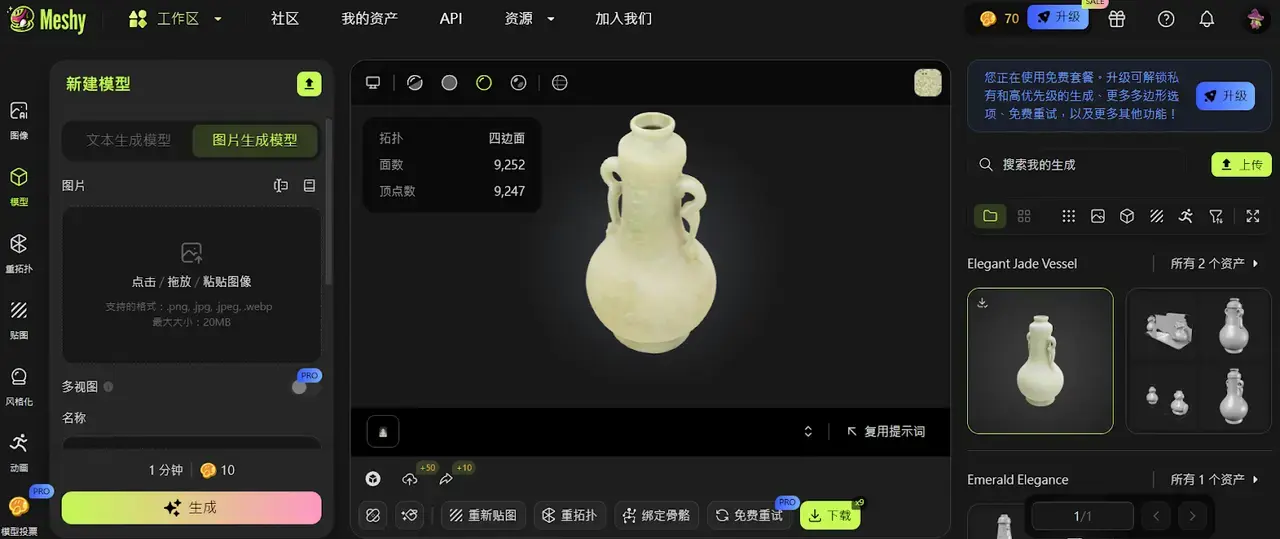
Discovering Meshy completely changed this dynamic. Meshy made it possible for students to turn their 2D jade designs into polished and viewable 3D objects within minutes. For the first time, every student, regardless of technical skill level, could progress from cultural appreciation to full creative production in an authentic and achievable workflow.
A Cross-Disciplinary Curriculum Powered by AI, VR, and Meshy
His course, titled “Jade Encounters: Time-Space Treasure Bureau,” follows a progression of understanding, creation, transformation, and exhibition. Students begin by studying the beauty of Qing Dynasty jade, learning about symmetry, carving techniques, decorative patterns, and cultural symbolism through digital resources from the National Palace Museum. With this foundation, they move into creative work by using AI tools to observe, imitate, and redesign artifacts. They practice image-to-text analysis and apply image-to-image tools to reinterpret historical jade in personalized ways.
Meshy becomes essential at this creative stage. After completing or redesigning jade in 2D, students upload their images into Meshy to transform them into fully dimensional models. This moment often becomes the highlight of the lesson because students react with excitement when their drawings suddenly appear as interactive 3D artifacts. Once refined, the models are exported as glb or fbx files and placed into the VR gallery, turning the classroom into a miniature digital museum.
Some students took the process further by experimenting with multiple image inputs of the same design to generate more accurate or stylized models. Through this experimentation, they gained a deeper understanding of prompts, structure, and the relationship between 2D form and 3D construction.

Visible Changes in Student Learning and Engagement
The improvement in learning outcomes was immediate. Students evolved from creating only flat artwork to producing redesigned jade pieces, fully interactive 3D models, and complete VR exhibitions. Their spatial awareness improved significantly as they learned how form, volume, and detail behave when viewed from different angles in three-dimensional space.
Their enthusiasm also increased dramatically. Students who had once been passive became active participants, often asking when the next class would begin.
One student commented: "I didn't expect AI could turn a single picture into a 3D model. It feels like magic."
Another shared: "I used to think jade artifacts from the Palace Museum were distant and untouchable, but after redesigning one myself, I feel much closer to the history behind it."
A third student expressed pride in presenting his redesigned jade in VR, describing it as the feeling of curating a real exhibition.

The Value Meshy Brings to Cultural STEAM Education
For his course, Meshy solves the most persistent challenge of the entire curriculum, the difficulty of enabling students to move beyond 2D creation without requiring advanced modeling skills. Meshy allows them to focus on cultural analysis, symbolism, creative thinking, and aesthetic exploration while still producing compelling 3D results that feel professional.
Chen-Ting sees Meshy as a bridge that links the richness of historical tradition with the possibilities of modern technology. Through Meshy, students can experience heritage in a new way, gaining the ability not only to observe artifacts but to reinterpret them, redesign them, and present them in a contemporary digital form.
Future Directions for AI-Integrated Cultural Learning
Building on the success of this project, Chen-Ting plans to expand the curriculum even further. He aims to include themes from Taiwanese Indigenous culture, encourage more advanced VR exhibition formats, and introduce AI-assisted workflows in upper-level ICT and digital art classes. His long-term vision is to help students explore the intersection of cultural heritage, creative design, and emerging technologies, allowing them to appreciate tradition while imagining new possibilities for the future.
He also encourages educators who hope to implement similar projects to prepare materials in advance, design structured worksheets, allow time for technical troubleshooting, and include opportunities for peer sharing and reflection. With thoughtful planning, Meshy can empower students to build their own digital museum and experience the joy of transforming imagination into immersive reality.
Additional Resources and Contact Information
Welcome to explore Niceday website for more information. For any questions, you can reach the teacher at niceday49@gmail.com.