In Samsun, a city in northern Türkiye, there stands a specialized educational institution dedicated to gifted students—the Samsun Science and Art Center, the first of its kind in the city.
Murat ERGÜN, a Technology and Design Specialist Teacher here, has long been committed to providing students with a learning experience that goes beyond traditional classrooms. For years, he has focused on guiding students in project-based learning and scientific research in the field of engineering, while also actively exploring the deep integration of cutting-edge technology and education.
"AI and VR technologies are the key to unlocking students' creativity."
Murat ERGÜN
Teacher

Dual Dilemmas in Traditional Teaching and 3D Modeling
When it comes to nurturing gifted students, the limitations of traditional teaching models have become increasingly apparent. In conventional classrooms, students mostly passively receive knowledge, struggling to connect abstract theories with practical experiences. This is particularly evident in the teaching of the history of science—where the achievements and experimental processes of great scientists often remain confined to the pages of textbooks, lacking intuitiveness and interactivity.
At the same time, students need to participate in various high-level competitions such as TÜBİTAK competitions, the International Mathematics Olympiad, and International Robotics Competitions. However, traditional 3D modeling tools have become a major obstacle for them. These tools are complex to operate and time-consuming, making it difficult for students to quickly obtain the 3D models they need.
A great deal of time is wasted on technical operations, which instead diverts their attention from the core creativity of the project and the essence of science.
Additionally, some students have not yet acquired advanced 3D modeling skills, making it hard for them to efficiently transform their ideas into visual outcomes and fully showcase their abilities in competitions.
Meshy: The AI-Powered 3D Modeling Tool to Overcome Dilemmas
By chance, Murat ERGÜN first learned about Meshy through Instagram stories. During his first trial, he was amazed by its powerful functions—the 3D textured model of Albert Einstein generated by Meshy was almost identical to the real figure .
The emergence of Meshy precisely addresses the dual challenges of traditional teaching and 3D modeling. It can quickly convert 2D images into 3D models in just one minute, eliminating the cumbersome process of traditional modeling. Moreover, it is equipped with an AI-driven text-to-image translation feature, which can directly generate 3D environments such as laboratories based on text descriptions .
For students lacking advanced modeling skills, Meshy lowers the threshold for 3D design. It allows them to focus on creative expression and the core goals of the project without getting bogged down in technical details, thus clearing the technical hurdles on the path of scientific exploration for gifted students .
The Complete Workflow from 2D to VR: Synergy Between Meshy and Delightex
To fully leverage the advantages of Meshy in teaching and competition projects, Murat ERGÜN has designed a clear and structured workflow for students, ensuring that every step can be implemented accurately:
1. Scientist Selection: First, determine the list of outstanding scientists to be featured in the project, such as Einstein, Marie Curie, and Ibn Sina.
2. 2D Image Collection: Search the web for high-resolution, full-length 2D images of these scientists to lay the foundation for 3D conversion.

3. Meshy 3D Asset Generation: Guide students to master the core usage of Meshy—on one hand, learn how to obtain high-resolution 2D images to ensure the conversion effect, and on the other hand, master the skills of writing prompts for text-to-image conversion. Then, use Meshy to convert the collected 2D images of scientists into 3D models, and at the same time generate 3D environments such as laboratories through text.
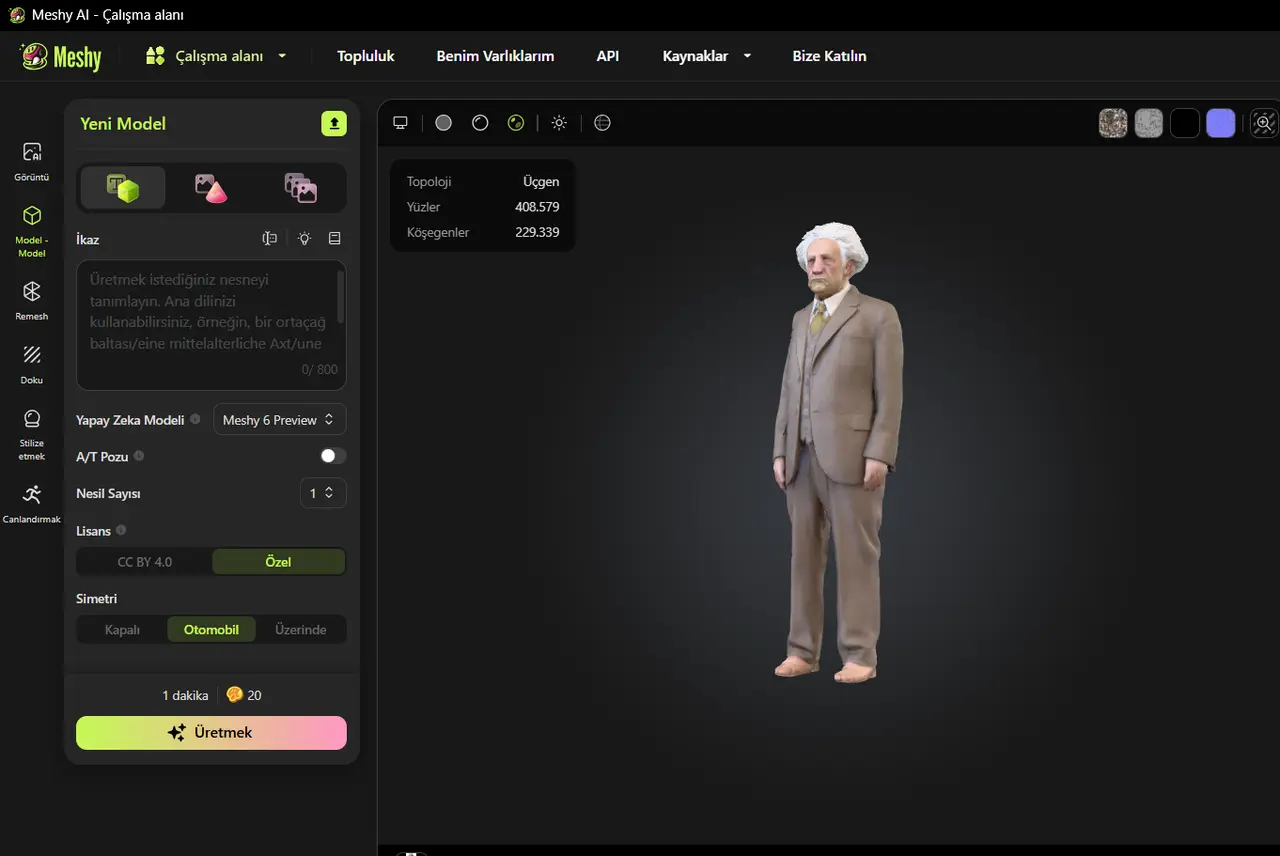
4. VR Application Upload: Upload all the 3D models and 3D environments generated by Meshy to the Delightex virtual reality application platform through the 3D model addition tool in the application.
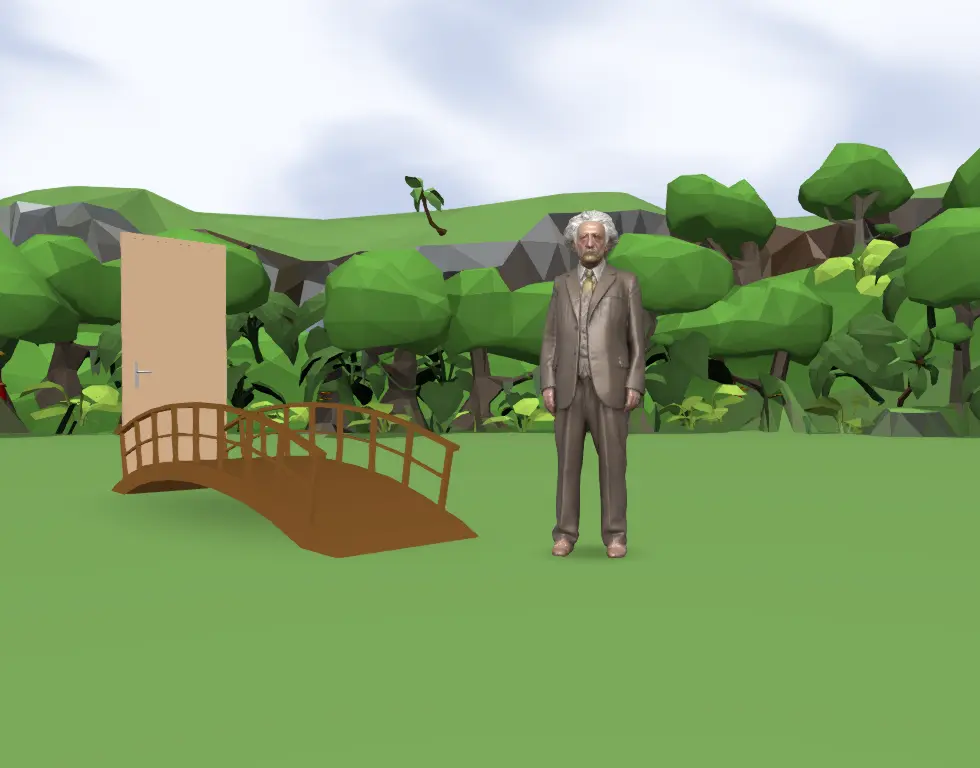
5. Content and Interaction Design: With the help of AI voice-over technology, enable the 3D scientist models to tell students about their research achievements and discoveries. At the same time, set interactive actions for the VR scenes through coding to achieve an immersive experience.
6. Final Presentation: Students enter the virtual museum or classroom through VR headsets, interact with the 3D scientist models, observe their experimental processes, and complete multi-sensory learning.
Throughout the workflow, Murat ERGÜN guides students the entire time to ensure they can proficiently use various functions of Meshy, while encouraging them to independently explore the potential uses of the tool.
The Implementation of Immersive Learning: The Transformation from Idea to Outcome
Through the collaborative application of Meshy and Delightex, an innovative VR learning environment has been successfully created. Students no longer just look at scientists from a distance through textbooks; instead, they can step into virtual laboratories and witness Marie Curie's experiments on radioactivity with their own eyes, and listen to Einstein explain the core ideas of the theory of relativity.
This learning method, which integrates visual, auditory, and experiential elements, makes history of science lessons vivid, interesting, and unforgettable, greatly enhancing students' learning engagement and knowledge absorption efficiency.
During the project advancement, students not only efficiently completed the creation of 3D assets and the construction of VR scenes but also achieved significant growth in various abilities in the process.
They no longer had to be troubled by the technical difficulties of traditional 3D modeling and could instead devote more energy to exploring the project's creativity and scientific connotations. Core 21st-century skills such as teamwork, problem-solving, and critical thinking were also fully exercised in practice. Moreover, this innovative project that integrates AI and VR technologies is expected to stand out in the TÜBİTAK competition with its uniqueness and scientific nature, attracting the attention of judges.
Future Outlook and Advice for Educators
Regarding the role of Meshy in future teaching, Murat ERGÜN has clear expectations: it is not just a 3D modeling tool but also a bridge connecting traditional course content with students' creativity. It can transform abstract knowledge into concrete and tangible visual experiences, turning students from passive recipients of knowledge into active creators.
"3D AI tools like Meshy have the potential to completely transform the educational process—a history student can reconstruct an ancient city in VR, and a biology student can observe a 3D cell structure up close. This kind of experiential learning will make classrooms more personalized, dynamic, and memorable."
Murat ERGÜN
Teacher
At the same time, Murat ERGÜN also shared three pieces of advice with fellow educators who hope to integrate AI into VR or competition projects:
- Take it step by step and focus on the process rather than rushing for results.
- Choose easy-to-use, accessible tools that can collaborate well with educators, such as the AI-powered Meshy.
- Have the courage to try and make mistakes, because these projects themselves are a process of exploration and experimentation, and any mistake is a valuable opportunity for students' growth .
With the continuous penetration of AI and VR technologies in the field of education, the practice of Murat ERGÜN and his students has proven that tools like Meshy are redefining the learning methods of gifted students. They not only empower students in competitions and career development but also play a crucial role in cultivating innovative and interdisciplinary talents who can meet future challenges.
We have reason to believe that with the support of cutting-edge tools like Meshy, more educational innovation practices will continue to emerge, making learning more imaginative and full of possibilities.
So, whether you’re an educator wanting to make learning leap off the page, a student with a competition-winning idea, or a creator with a world to build—Meshy is your shortcut to stunning 3D. Try it now, and let your creativity fly without limits.